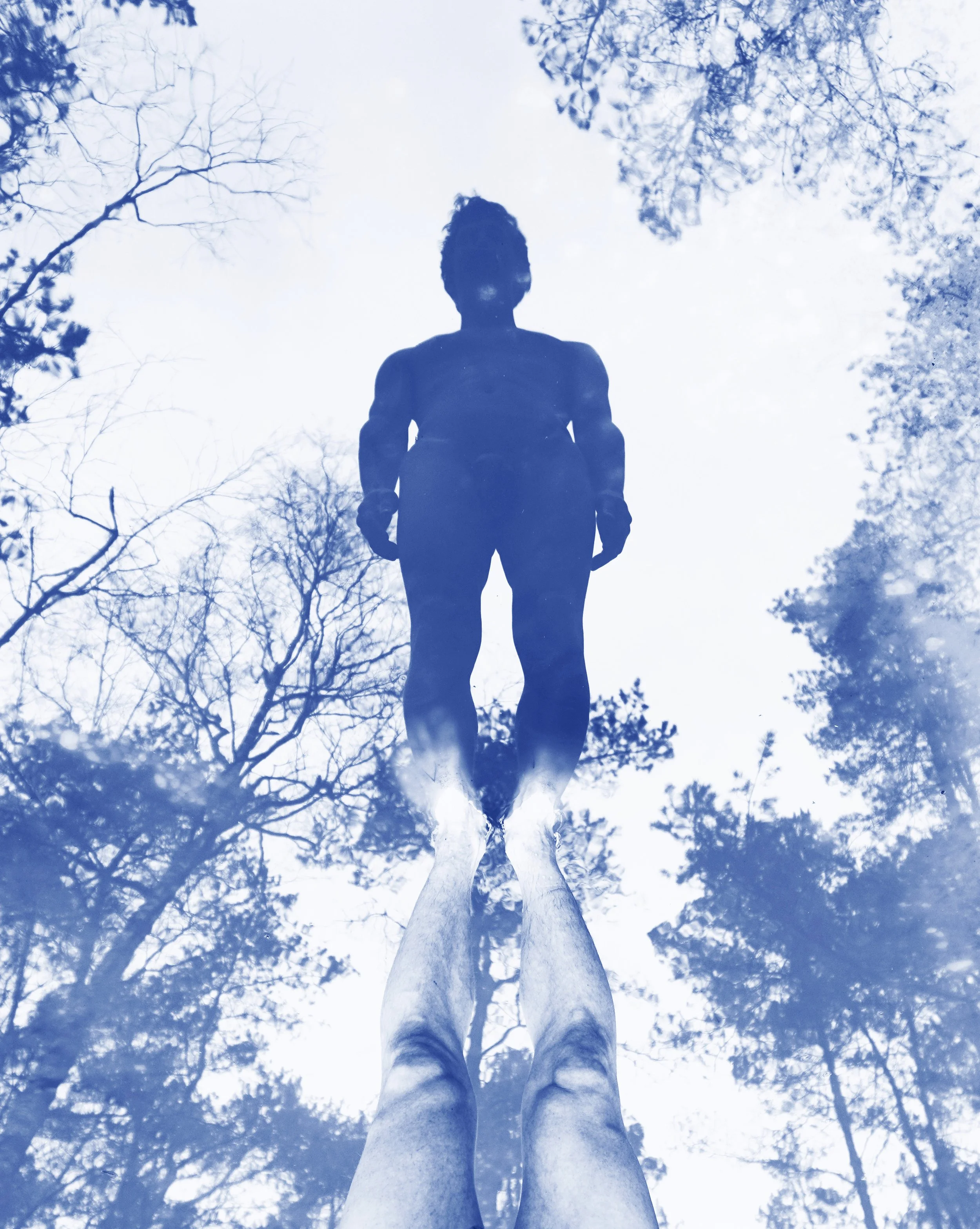
My work begins with the simple question “where does my body end and the world begin?”
I work with industrial materials—metal, bearings, motors, mechanical systems. Yet I am not interested in mechanical motion for its own sake. What fascinates me is the possibility of using these materials to evoke movements that feel alive: the rhythm of breathing, the drifting descent of a winged seed, the swaying of a branch in the wind, the subtle adjustments of a body finding balance.
When viewers encounter these movements, they often project themselves into them. They recognize a sensation rather than an object. A rotating form may feel free, resilient, vulnerable, effortless, or contemplative. In that moment, the work becomes more than a machine; it becomes a site of emotional identification.
This exploration emerged from my earliest experiments. Shortly after graduating, I built kinetic sculptures consisting only of moving metal structures. They had no figurative shapes and did not resemble plants, animals, or human figures. Looking back, I realize that those works already contained the central question of my practice: how can something undeniably mechanical evoke the feeling of a living presence?
Over time, I came to understand that what interests me is not imitation of nature, but the relationship between humans and nature itself.
Modern society often encourages us to think of ourselves as separate from the natural world. We imagine a boundary between "human" and "nature," between culture and ecology, between technology and life. Yet as living organisms, we are inseparable from the same processes that shape trees, animals, rivers, and forests. We breathe, decay, adapt, grow, and respond. We are not outside nature; we are one of its expressions.
My sculptures attempt to make this continuity perceptible. Through movement, I seek to create moments in which viewers recognize themselves not as detached observers, but as participants in a larger living system. The works invite an embodied response before an intellectual one. They ask us to feel our kinship with other forms of life before we define or categorize them.
In a world increasingly organised through systems of production, efficiency, and abstraction, we risk becoming estranged from our own embodied existence. We forget that we are creatures as much as we are individuals. My work is an attempt to recover that awareness—not through representation, but through the experience.
By giving metal the qualities of breath, drift, hesitation, and persistence, I hope to reveal something that already exists beneath the surface: the continuity between the human body, the natural world, and the forces that move them both.
Nijboer exhibits his work both nationally and internationally. He graduated in Fine Arts at ArtEZ Academy of Arts in Arnhem in 2014. He stayed in Arnhem with his studio. His work Naked Skin is on display in the permanent collection of the Het Depot sculpture gallery in Wageningen, and several of his sculptures can be seen in public outdoor spaces. Nijboer has received two grants from the Mondriaan Fund to further develop his artistic practice.